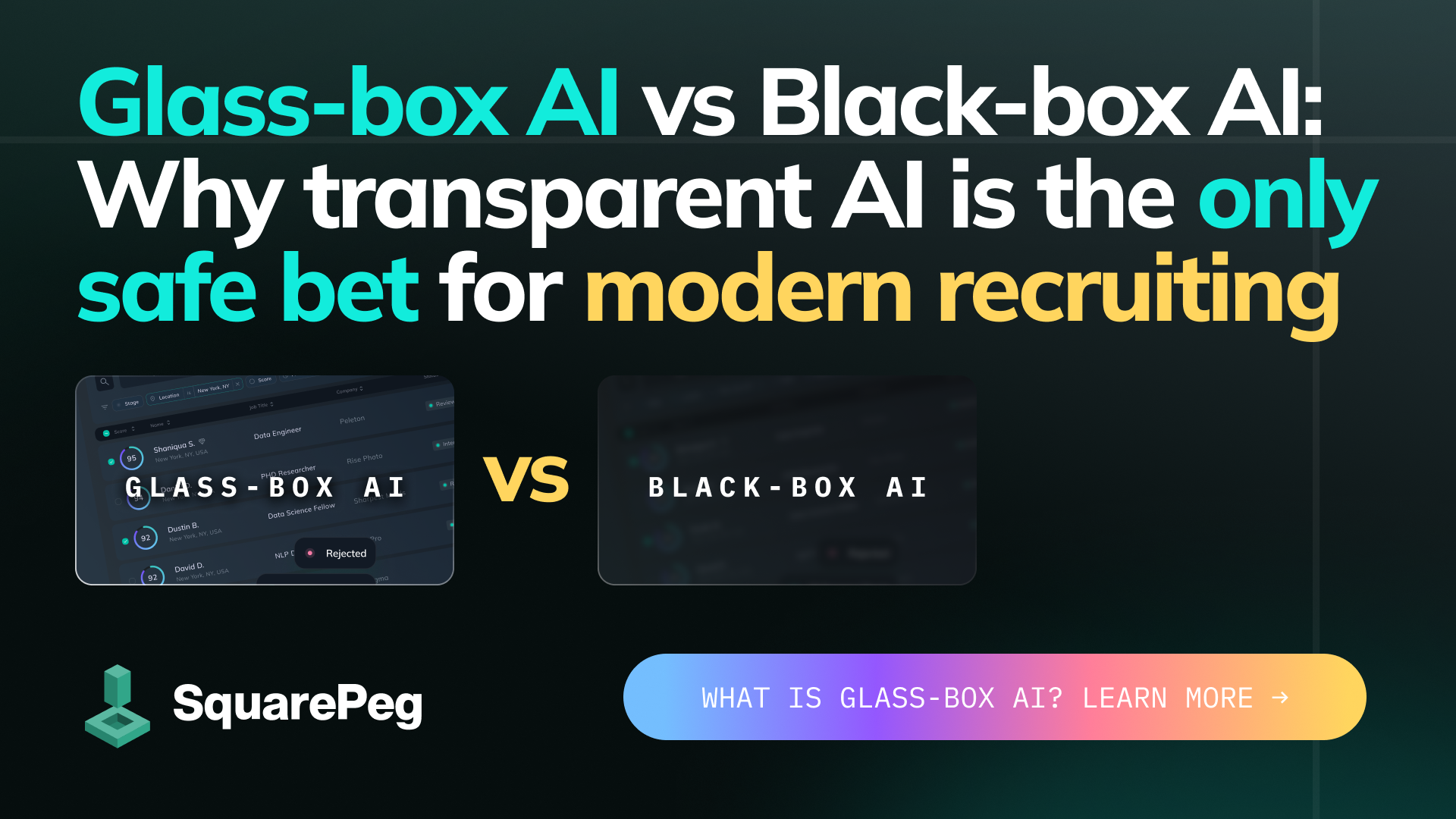
What exactly is Glass-box AI and what is the importance of understanding what Black-box AI is? And what transparent AI recruiting software or glass-box AI for recruiting exists today? Let's dive in.
Applicant volume is up, resume quality is uneven, and fraud risk is no longer hypothetical. So it makes sense that teams are leaning on automation to tame the top of the funnel. The question is not whether to use AI. It is which kind of AI you are willing to trust.
SquarePeg takes the other path. We use glass-box AI that shows the “why” behind every decision, so recruiters, hiring managers, and candidates can see what drove the outcome. This article explains why opacity is risky, what real transparency looks like, and how to operationalize explainable AI resume screening that saves hours without sacrificing fairness.
The pressure cooker recruiters are in Across conversations with Talent Acquisition and Recruiting Ops leaders, the patterns keeps showing up:
Applicant pipelines are overflowing and many resumes look identical Keyword-stuffed applications game basic filters Fraudulent or AI-fabricated profiles are on the rise Lean teams have less time for candidate care, yet expectations are higher To deal with this massive flood, many teams reach for AI screening for job applicants. The intent is right. The implementation is where risk creeps in. If the tool cannot show why it scored Candidate A at 89 and Candidate B at 71, it leaves the humans accountable for the result without the information they need to stand behind it.
What exactly is "Black-box AI" Black-box AI is any system that produces an output without making its inputs, features, or reasoning observable to the user. You see a score or a shortlist. You do not see the ingredients or how they were weighted.
No answer to “why”. You cannot explain a score to a candidate or a hiring manager.Bias is hard to detect. Without visibility you cannot tell whether the model latched onto the wrong signals.Compliance Exposure. If regulators or legal teams need an audit trail, there is nothing to show.Vendor dependency. You are locked into a system whose logic you cannot evaluate or compare.Erosion of trust. Recruiters and candidates are less likely to accept outcomes they cannot interrogateBlack-box AI can be fast, but it keeps the humans in the dark. And when humans are accountable for hiring decisions, darkness is not your friend.
Enter Glass-box AI: Transparency you can trust Glass-box AI makes the reasoning visible. That does not require revealing every algorithmic nuance, but it does require intelligible evidence for every outcome. In practice, a glass-box AI recruiting tool should provide:
Reason codes that explain why the model scored or ranked a candidate Feature breakdowns that show which skills, experiences, or signals drove the score Confidence levels that communicate when the data is strong or weak Human in the loop controls that let recruiters override, comment, and learn Audit trails that log what was decided and why Transparency is not a nice-to-have. It is how to learn, calibrate, and improve the quality of hire.
What does transparent AI screening look like? An explainable workflow for screening job applicants with AI can be both rigorous and human-friendly. Here is a pattern we use and recommend:
Start with data enrichment. Resumes should be enriched with structured data: inferred skills, industry tags, tenure patterns, education, and relevant work experience context.Role definition as outcomes, not laundry lists. Ask hiring managers to identify the five competencies that drive business success for the role. Prioritize them.Model scoring followed by coded rationale. Score candidates against competencies and showcase the “why”: demonstrated proficiency, evidence sources, and gaps.Confidence scores and risk flags. Identify thin resumes, suspicious inconsistencies, and predictions that deserve human review.Human review and annotation. Recruiters should accept, modify, and override scores with notes that can also be used as training data.Audit and feedback loops. Connect early scores to 30/60/90 day outcomes, recalibrate, and track progress over time.The net effect is a shortlist you can defend and a process that gets smarter with every hire.
Compliance cases for Glass-box AI Regulators are paying closer attention to automated decision systems. Even if you are not under a formal mandate, good practice today looks like this:
Keep documentation of how candidates were evaluated Retain explainability artifacts for each decision Run fairness checks across demographic segments Maintain human oversight with the ability to override Provide candidate-facing explanations when requested Black-box AI makes those steps difficult or impossible. Glass-box AI approaches make them routine.
Measuring impact without losing the plot If you are evaluating tools, measure the things that matter:
Time to shortlist -> How many recruiter hours does the tool realistically save per req.Signal quality -> The percentage of first-round interviews that advance.Candidate experience -> Candidate NPS and the clarity of the rejection rationale.Fairness indicators -> Stability of pass-thru rates across cohortsHow SquarePeg delivers Glass-box AI Built for teams that need to move quickly and explain their decisions. Our approach to AI resume screening and top of funnel triage is intentionally transparent.
Explainable scoring. Every score comes with reason codes: which competencies were evidenced, where the signals came from, and where the gaps are.Data Enrichment. We expand each profile with structured signals like skill depth, company context, tenure stability, and project complexity, so ranking isn’t just a keyword race.Confidence indicators. You see when data is strong, thin, or potentially inconsistent.Human Control. Override any decision, add notes, and create rule-based preferences that match how your team hires.Instant Rescoring. If the role priority changes or a new skill becomes critical, update your rubric and watch the pool re-rank in seconds.ATS-Friendly. We meet you where you already work, so adoption is low friction.This is glass-box AI in practice. Recruiters get signals and context. Hiring managers get clarity. Candidates get fairness and a clear explanation when they ask for one.
A practical example: From top of funnel to proof Imagine a data analyst role with hundreds. No wait, thousands of applicants. The old way is a keyword pass, then human sifting. Here is a breakdown of a practical example on how modern AI goes from top of funnel to proof:
Intake enriches applicants with signals like SQL depth, analytics tooling, industry domain, and scale of data environments. The hiring manager defines five outcomes: build robust dashboards, own stakeholder requirements, optimize pipeline performance, prototype models, and communicate insights. SquarePeg scores and explains each candidate with our glass-box AI. Recruiter sees a confident shortlist with reason codes, scores, and risk flags. After hire, 30/60/90 outcomes are scored and tied back to the model’s predictions. The next search calibrates accordingly. Everyone sees the same picture, and your team can explain the decision with facts, not vibes.
The hidden costs of blackboxes Opaque tools AI recruiting software often look cheaper or easier to deploy because they abstract away complexity. The bill comes due later:
Time lost defending or re-running unclear decisions. Missed candidates who never made it through keyword walls. Reputational damage when candidates feel the process is arbitrary. Legal exposure when you cannot produce a rationale for outcomes. Change-management drag because recruiters do not trust the tool. If you are choosing an AI recruiting tool, ask the vendor to show you the “why” behind a real score on one of your live roles. If they cannot, you are buying speed without accountability.
How to evaluate vendors through a glass-box lens Use these quick tests when you trial AI screening for job applicants.
Reason codes on every score. Can the system tell you what drove a ranking.Feature transparency. Can you see the key signals and their weights?Adjustable rubrics. Can you change the importance of skills and instantly rescore them?Confidence and risk. Does the tool identify thin or suspicious resumes?Human override. Can recruiters annotate and correct the model?Evidence export. Can you export candidate audit explanations?If the answers are no, you are looking at black-box AI with a new coat of paint.
Why Glass-box AI helps candidate experience At the end of the day, Candidates are looking for their next role. But they also understand that they cannot expect a job that they apply for, but they do expect a fair process.
Transparent screening helps you deliver that:
You can give a meaningful explanation for a rejection You can point to specific gaps for future improvement You reduce the perception that hiring is arbitrary You protect your brand in a market where word travels fast Transparency costs little and earns a lot.
FAQ What is glass-box AI in recruiting?
Glass-box AI in recruiting is a transparent artificial intelligence system that shows exactly how and why it scores, ranks, or filters candidates. Unlike black-box AI, glass-box systems provide reason codes, feature breakdowns, and confidence levels for every decision, enabling recruiters to explain outcomes to stakeholders and ensure compliance.
Is “AI resume screening” just keyword search with lipstick?
It can be. True screening enriches resumes with structured signals, scores candidates against a prioritized competency model, and produces reason codes you can act on.
Will transparent AI slow us down?
Not with the right system. And the right system gives you instant clarity. Recruiters save hours because they stop guessing and start focusing on conversations that matter.
Does glass-box AI improve fairness?
It does. You can see which signals drive outcomes, run fairness checks, and correct drift early. By revealing which factors influence scores, teams can identify and correct bias patterns. Our system monitors for adverse impact in real-time and flags statistical anomalies. Opaque systems make that impossible. SquarePeg's glass-box AI meets all regulations.
Can glass-box AI integrate with our ATS?
Yes, SquarePeg integrates with Ashby, Greenhouse, Lever, Workable, Workday, BambooHR and 100+ other systems via API or native connectors.
How is SquarePeg different from other AI recruiting tools?
Unlike competitors using black-box models, every SquarePeg decision includes explainable reason codes, adjustable scoring weights, and complete audit trails. All updated in real-time.
The Bottom Line: Choose Transparency, Build Trust, Reduce Risk AI is here to stay in recruiting. The real choice is between speed you cannot explain and speed with signal you can stand behind. Black-box AI moves fast and breaks trust. Glass-box AI moves fast and builds it.
SquarePeg was built for the second path. We enrich data, score transparently, and show the “why” behind every match, so your team can move from top of funnel to confident shortlists and give candidates the fairness they deserve.
Ready to see glass-box AI in action? Get your hours back and keep the “why.”


.svg)


.svg)


